
One Job, Done Well
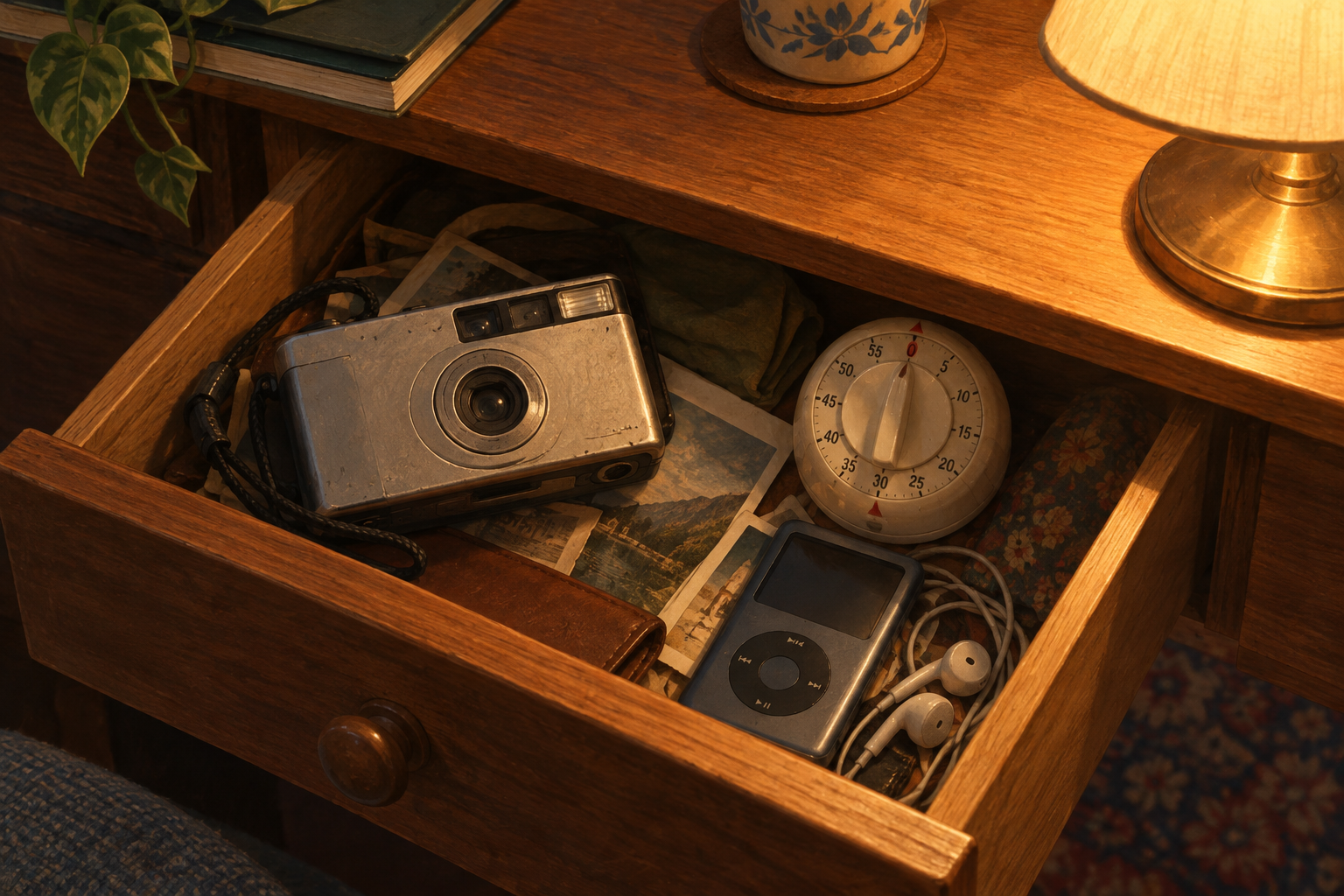
I have a drawer full of dead batteries and old chargers, and buried in it is a little point-and-shoot camera that does exactly one thing: take pictures. No filters, no cloud sync, no notifications begging me to share. You press a button, it makes a small mechanical sound, and somewhere inside it, light becomes a photo. That’s it. That’s the whole feature list.
I’ve been thinking about why I still reach for it, even though the phone in my pocket takes technically better pictures. It’s not nostalgia, exactly. It’s something closer to relief.
The Case for Doing One Thing Well
Somewhere along the way, we decided every device should try to be every device. Your phone is a camera, a music player, a notebook, a flashlight, a mirror, a boarding pass, and a slot machine, all at once. That’s impressive engineering. It’s also exhausting in a way we rarely stop to name.
When a tool does one job, it tends to do that job with a kind of clarity. There’s no app update interrupting your shot. No pop-up asking if you want to back up to a service you forgot you signed up for. The dumb device just works, in the old, boring sense of that word.

A Short List of My Favorite Single-Purpose Gear
- An old point-and-shoot camera — takes photos, holds them on a card, asks nothing else of me.
- A dedicated music player — no feed, no comments, no algorithm trying to guess my mood.
- A wind-up kitchen timer — louder and more honest than any phone alarm I’ve set.
- A paper notebook — can’t sync, can’t crash, can’t be acquired by another company and quietly shut down.
None of these are rare or expensive. That’s kind of the point. Their value isn’t in specs, it’s in restraint.
What Gets Lost in the All-in-One
I don’t think the all-in-one device is a scam or a conspiracy. It’s genuinely useful to carry one slab of glass instead of six separate gadgets. But usefulness and attention are different currencies, and the multi-tool device spends your attention constantly, even when you don’t ask it to.
Every single-purpose gadget I own has a kind of boundary built into it. The camera can’t check my email. The music player can’t show me a headline about something upsetting halfway through a song. The limitation isn’t a bug, it’s the entire design. When a device can only do one thing, it can’t quietly expand into doing everything.
Contrast that with a phone, where the boundaries are entirely up to you to enforce, constantly, forever, against a product built by people whose job is to make enforcing those boundaries as hard as possible. That’s not a fair fight, and I say that as someone who has lost it more times than I’d like to admit.
Friction Is a Feature
There’s a particular kind of friction that’s good for you. Winding a timer. Pressing a physical shutter button. Flipping a page in a notebook instead of tapping a screen. These small bits of resistance slow you down just enough to be present for the thing you’re actually doing, instead of sliding past it on the way to the next notification.
I notice this most with photography. When I shoot with the dumb camera, I take fewer pictures, and somehow I like more of them. There’s no instant preview tempting me to retake the shot six times. I just take it, and move on, and trust that it probably turned out fine. That trust is its own kind of pleasure, one that the infinite-retake world of smartphone photography quietly took away without me noticing.

This Isn’t an Anti-Phone Rant
I’m not giving up my phone. I’m not telling you to either. It’s genuinely one of the great tools humans have built, and pretending otherwise is its own kind of performance. What I’m saying is smaller than that: it’s worth keeping a few dumb devices around on purpose, as a counterweight.
A single-purpose tool is a kind of promise. It promises that when you pick it up, you already know what’s about to happen. No surprises, no updates, no sudden pivot into something the manufacturer decided was more profitable this quarter. In a world of devices constantly trying to become something new, there’s something almost radical about a thing that’s content to stay exactly what it is.
Try It for a Week
If you’ve got an old camera, an unused music player, or even just a kitchen timer sitting in a drawer, pull it out and use it for a week instead of the phone equivalent. Not as a stunt, just as an experiment. Notice how it changes the rhythm of the task. Notice what you don’t reach for afterward, out of habit, because the dumb device already did its one job and stepped out of the way.
That stepping out of the way, I think, is the whole appeal. The best tool is sometimes the one that knows when to disappear.